Kingman, AZ · Garage Door Service
Emergency Garage Door Repair for Yucca's Older Doors
Yucca's garage doors mostly date to 1977, older than the rest of the service area. Here's what breaks first, what it costs, and how a 23-mile callout from Kingman works.
- Repairs & new doors
- Springs & openers
- Serving 5 nearby communities
Doing It Yourself
Before you touch anything, know what you're dealing with. Most garage doors out in Yucca went up around 1977 - that's two decades older than the newer stock closer to Kingman proper, where building picked up heavy in the late '80s and '90s. A door from that era is usually a single steel panel, not the insulated sectional type that's common now, and it almost always runs on one torsion spring instead of two. That matters because a single-spring setup under full tension can whip a lot harder when it lets go, and the mounting hardware on a door this old is frequently rusted or undersized by today's standard.
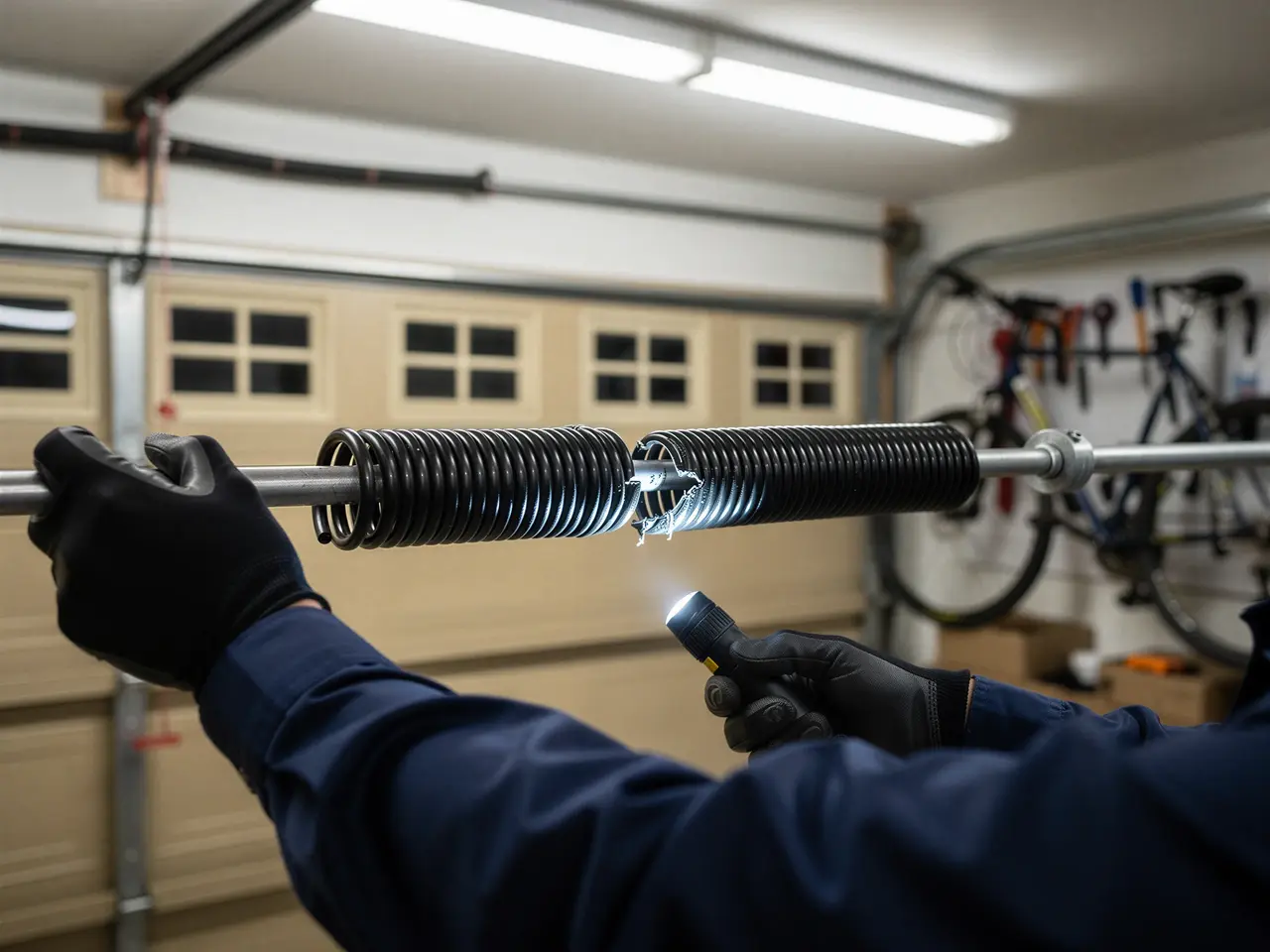
If the door won't open and you can see the spring is intact but the cable's jumped the drum, you can sometimes walk the door down by hand to relieve tension - but only if the door is already most of the way open and the spring looks unbroken. If the spring itself is snapped, stop. Don't cut the cable, don't try to re-tension anything by hand, and don't let anyone stand under a door held up by a bar clamp or a ladder. A door this age on original hardware is not a safe DIY repair once the spring's gone.
Where This Job Goes Sideways
The usual trap with a 1977-era door is assuming it takes the same parts as anything newer. It doesn't. Drums, end bearings, and track brackets from that period were often sized to a door gauge nobody makes anymore, and a tech showing up with standard modern stock can find the hole pattern just doesn't line up. That's where a quick fix turns into a second trip.
The other place it goes sideways is tension. On an older single-spring door, the winding cone and shaft were frequently never upgraded to current safety standards - no cable drum safety loop, sometimes no set screw backup. We won't force a modern part onto hardware that isn't built for it, and we won't rush a wind-down on a cone that's corroded past the point of trusting it. That sometimes means the honest answer is replacing the spring assembly outright rather than patching the old one, which costs more up front but doesn't put you back in this spot in six months.
What You Pay
We don't post a flat number for this because the parts situation out here varies job to job - a door on its original 1977 hardware can need something as simple as a cable, or it can need a full spring and drum swap because nothing on the shaft matches current stock. What we can tell you is that income across this part of the service area runs lower than the surrounding towns - median household income here sits around $31,875, well under the roughly $43,272 figure for the wider area Kingman Garage Door Pros covers. We factor that into how we talk about repair versus replace: if a door is original from '77 and the track is bent along with the spring, we'll tell you straight when fixing it piece by piece costs more than it's worth, instead of running up a bill on a door that's going to need the next part in a year anyway.
Parts We Carry
The truck carries the parts that cover most doors built from the late '80s onward - standard torsion springs in common wind sizes, galvanized cable, nylon and steel rollers, and universal opener logic boards. What it doesn't carry as standard is older single-spring hardware sized to 1970s doors, since that stock isn't common across the rest of the service area and doesn't move fast enough to keep on the truck. For a door out in Yucca built to that older standard, there's a real chance the job needs a part ordered rather than pulled off the shelf that day.
We'll always check the door in person before promising a same-visit fix. If the bracket, drum, or cone is a size we don't carry, we'll tell you that on site, give you the real timeline for getting the right part, and won't swap in something close enough that it fits today and fails next year. That's the honest limitation here - older hardware sometimes means waiting, and we'd rather say that upfront than pretend otherwise.
What Causes It Around Here
Heat does most of the damage. The climate across this service area is rated severe for heat, and a steel door from 1977 has had close to fifty summers to bake, expand, and contract. That cycle dries out old lubricant in the rollers and hinges, and it's hard on the galvanizing on a cable that's original to the door - you get fraying at the drum long before the cable looks obviously worn.
The other factor is just low use of newer safety hardware. A door built to 1970s code often doesn't have the cable drum safety features that became standard later, so when a cable does start to go, there's less built into the door to stop a sudden drop. Combine decades of heat cycling with hardware that predates current safety standards, and the failure pattern out here tends to be sudden - a snapped spring or a slipped cable - rather than a slow, gradual stiffening you'd catch early.
How We Fix It
Yucca sits about 23 miles out from Kingman, so a callout here is a planned trip rather than a five-minute drive, and we're upfront about that when you call. We don't keep a branch or a depot in Yucca - the truck comes from Kingman, loaded with what it can carry for that specific job based on what you describe on the phone.
Once we're on site, the first move is always diagnosis before parts: we check the spring wind, the drum and bracket sizing, and the track alignment before touching anything. If it's a standard fix with stock parts, we do it that visit. If the hardware is original to a door this old and needs something we don't carry, we'll tell you what it is, what it'll take to get it, and give you a straight timeline - not a vague one. The goal on a door this age is getting it safe to use again without pretending a 1977 door and a 2024 door take the same parts, because they don't.
Frequently asked questions
Why doesn't the truck already carry parts for my door if it's been out here since the '70s?
Most of the doors across the wider service area date from the late '80s and '90s, so the truck is stocked for that hardware. A door built in 1977 often uses an older spring cone, drum, or bracket size that isn't common stock anymore. We'll check it in person and tell you straight if it needs an ordered part.
Is it safe to leave a broken spring on an old door until you can get out there?
Yes, as long as you don't try to open or close the door manually. Leave it shut, don't force the opener, and keep people and vehicles clear of the door path. A door with a broken spring isn't going anywhere on its own, but it can drop hard if someone tries to force it open.
How far out is Yucca from where you're based?
About 23 miles from Kingman. We don't keep a branch in Yucca, so every job here is a planned trip from Kingman rather than a short local hop, which is worth knowing if you're trying to estimate timing on a callout.
Is it worth repairing a door this old or should I just replace it?
Depends on what's actually broken. A snapped spring or frayed cable on an otherwise solid door is usually worth fixing. But if the track's bent, the panel's rusted through, and the spring's gone, we'll tell you plainly when putting more money into original 1977 hardware doesn't make sense versus a new door.
Book garage door service in Kingman
Call now or request a quote - tell us what the door is doing and where you are.